
Global warming but still impressive.
Another WordPress weblog by Enno ter Keurst
Global warming but still impressive.

It sounds really nice, the adoption of open-source software and open standards to cut cost and the dependencies on individual companies. Anyone who looks further into this sees that it is more the case of “using only those open standards so certain companies are excluded”.
Netherlands Adopts Open-Source Software: Financial News – Yahoo! Finance

“McLaren apologises over spy findings” [link]
I have the feeling that the only reason why McLaren is doing this is because they know that they can never win this battle and that it would have dragged on and on. The whole investigation has always been “proving that you are innocent†instead of the FIA proving that McLaren is guilty. Something they never could have done so anyway. What do you think the outcome of the WMSC meeting would have been? Any mention in the report of a similar development in the McLaren and Ferrari car would have been explained as McLaren copying Ferrari.
Â


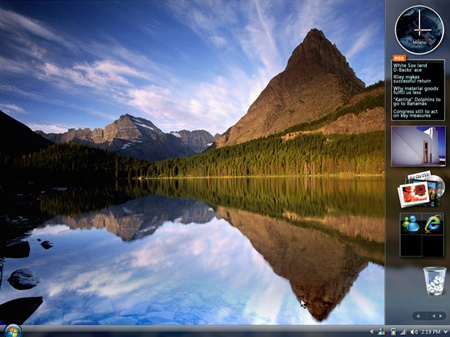
This weekend I took the plunge and tried Windows Vista on my desktop PC at home. The result: I like it! It is quick, the graphics are refreshing new and most of the software I own works. I know that as with most systems if you do a fresh install, the speed of the OS is the first thing you notice. So comparing it with a 2 year old Windows XP SP2 installation with loads of updates and installs and uninstalls of not fair.
I have been trying Vista since it came out in Beta. I have installed it on Tablet PC’s and as a virtual machines under VMware. Most of the problems I had were due to some hardware features which were not yet supported under Vista or where VMware did fully supported of the OS.
There has been a lot of flag about the security messages a user gets when he or she is doing something the OS things to be a security issue. I cannot say that I find this a problem. I am used to locking down desktops and making it impossible for users to install software and making change the OS. That of course is in a business environment. But I think home users should apply some of principles at home as well.
First they decide that the MP4-23 has to be checked on “illegal” Ferrari knowledge/parts. Now they decide that the results have to be shared with the competition and in a sense give them full inside on the construction and basics of the McLaren car.
When will this charade end?
[link]Â
During the Olympics in 2008 the athletes will have to tell the anti-doping organisation were they are every two hours. Not only during the games but also in the weeks leading to it (link).
I agree with the fact that we have to check atletes on the use of doping but forcing somebody to tell you where you are every two is over the top. I think we have to take a step back and look how we can do this without invading the privacy of the athlete.
It looks like to UK is introducing Dutch (Verdonk) like measures.
The EU’s antitrust chief Neelie Kroes warned banks on Monday that a new payment system should not be allowed to cut down choice or increase costs for customers.
….
Kroes suggested that national card payment schemes should be encouraged to join the SEPA scheme because that would introduce and increase competition to the benefit of merchants and customers.
The EU competition commissioner said she was working hard to wrap up an ongoing antitrust case against MasterCard Inc. The European Commission last year charged the credit card provider with illegal price fixing for setting the fees retailers must pay for accepting MasterCard and Maestro branded cards, saying this limits competition between banks who use the xservice.
“We want this decision to provide the industry with a solid competition analysis of the MIF as applied by MasterCard,” she said.
Kroes earlier signaled that Visa may also face further trouble ahead. In 2002 it won a temporary exemption from EU antitrust rules that allowed it to strike deals on interchange fees with banks that it might usually compete with.
This exemption expires at the end of the year and Kroes said in October that she was unlikely to simply extend it, warning that she had “the feeling that something should be done.”
Regulators have criticized the high level of these fees, saying card networks like Visa, MasterCard and American Express have failed to explain why they need to charge so much for handling payments.
This could mean that national systems could get another chance. Good!
Chad Lorenz wrote in Slate an article about the “Death of e-mail”. It was picked up by Thomas Hawk on his blog who celebrated it this development and said:
And I read this article and can’t help but keep muttering inside, “Yes. Yes! YES!!!! Die email die!”
Increasingly email is playing a smaller and smaller role in my own life. I used to spend hours every day in email. Checking my email. Answering emails. Following up. Sending my own email to others and merely perpetuating the problem. Email sucks. Now I spend maybe 30 minutes a day skimming my email, ignoring most of them, deleting most of them. Answering a few.
At present I have 3,002 messages in my email inbox. Of these 2,794 are unread. And this is already after committing email suicide once. One of the fortunate by products of my Mac’s hard drive recently failing was that it wiped out all of the 5,000+ messages that I could never quite get to.
Thomas was missing the point that Chad was making in his piece. Besides the fact that Thomas has a time management problem, it is about how we use communication devices and how we communicate these days.
Basically, contacts and communication have become more superficial and more casual. Take a look at how sites like Hyves, MySpace, Twitter and FaceBook operate. You sign up to the service and you try to expand your list of ‘friends’. Before you known you have hundreds of people who call themselves a ‘friend’ of you. But how many of those friends are really friends and how many are part of the service?
Last year an experiment was conducted in the Netherlands with some kids. As with most kids they were constantly texting their friends during the day. In the experiment they took away the cellphone for a week and looked what the effect off that was on their circle of friends. The most frustrating conclusion (for the kids) was that none in the circle of friends had missed them that week.
Another survey looked at how kids used e-mail addresses, login accounts and other identifiers on the Internet. I find one of the most frustrating things when somebody changed his e-mail address but has not informed me about this. This is one of the reasons why I took a personal e-mail address which I can take with me to any provider. The survey showed that kids just dumped e-mail addresses, changed login accounts when they forgot the password. Basically they did not care about the worries I had of being reachable on the net.
Sure, collaborating and Instant Messaging tools have found their ways into the corporate world. But that is simply because there is a business case. These tools enable organization to become more flexible, use resources and people more efficient and to respond quicker to opportunities. But they won’t eliminate e-mail. E-mail will remain the only formal way of communication in a company and kids moving into the corporate world will have to learn to communicate via formal channels. Maybe we can learn them something?